

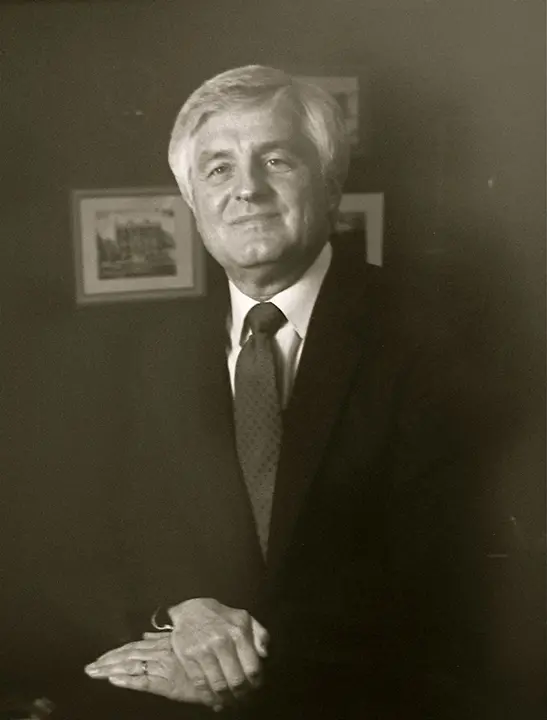




Rev. Durwood “Bud” Leroy Buchheim
July 27, 1923 – September 29, 2026
Durwood Leroy Buchheim was born on his family farm near Pumpkin Center, South Dakota, July 27, 1923.
Pumpkin Center, located eight miles south of Humboldt and 18 miles west of Sioux Falls, was, at the time, an early version of a modern-day convenience store – a place for gas, car repairs, and basic groceries (today, it’s merely a historical marker on the side of highway). His home at birth and throughout his years growing up was a two-story, 3-bedroom farmhouse with no closets and no indoor plumbing.
Though he was given the name Durwood at birth, he has been “Bud” nearly his entire life.
And it’s a life that many would describe as humble – and, yet, distinguished.
He grew up during the Depression, finding that poverty on the farm was likely better than poverty in a city. He and his family worked hard, but they always had ample food and housing that kept them mostly warm and mostly dry.
Just before his 18th birthday, he graduated from Humboldt High School and later that year enrolled in Augustana College. While at Augustana, he lived with his sister Berdie and her husband Harold Maxwell; it was his first home with modern plumbing. He worked part-time for Harold at Maxwell Hotel Supply. His dreams of becoming an engineer disappeared in his sophomore year – about the same time he encountered the subject called calculus. Bud would later say, “In retrospect, I think I learned more in the two years working in the restaurant supply business than I did at Augie!”
His pursuit of an engineering career ended as World War II was just getting underway. In November, 1942, with his good friend Yerke Larson, Bud hitchhiked from South Dakota to Minneapolis to complete his physicals and enter the V-5 Navy Program and become a pilot. On January 4, 1944, he completed his first solo training flight at the U.S. Naval Air Station in Pensacola, Florida. On May 16, 1944, he was commissioned as an Ensign. On April 19, 1945, he was headed to the forward area of the war in the Pacific, stationed at McGuire Field on Mindoro Island in the Philippines. Bud was now a member of the Patrol Bombing Squadron 117.
He would fly 36 missions until the end of the war later that same year, facing little enemy resistance during his missions. His squadron compiled the best composite combat record of all U.S. Navy Squadrons in World War II. Bud received a Distinguished Flying Cross and five air medals. He flew his last combat mission on August 10, 1945. He traveled home via Navy ship (his first time on a ship in his 3-year Naval career!) as a part of Operation Magic Carpet. On October 31, 1945, aboard the Saratoga aircraft carrier, he sailed under the Golden Gate Bridge. On December 28, 1945, he flew from Amarillo, Texas, to Hutchinson, Kansas – his last flight as a Naval aviator. He was promoted to Lieutenant (JG) and released from the Navy in early January, 1946. He was honorably discharged on May 15, 1956, having been part of the U.S. Naval Reserve for more than a decade.
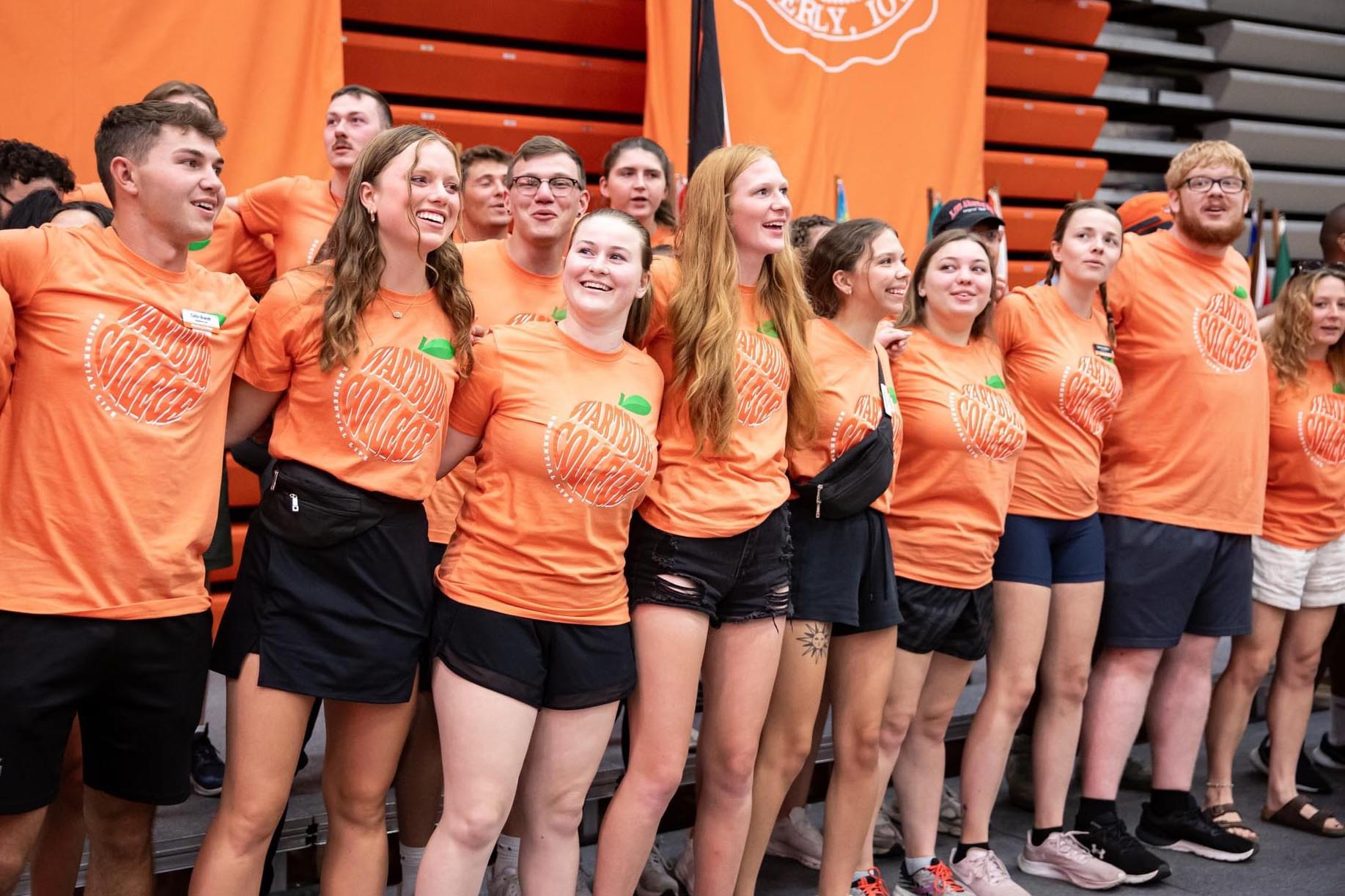
After the Navy, he reenrolled at Augustana College, but was quickly dissatisfied with his academic pursuits. He explored multiple careers with mixed success. He went into the trucking business with his brother Howard in Walla Walla, Washington. He called that quits after two years and went back to work for his brother-in-law Harold at Maxwell Hotel Supply. He was successful in this role with the promise of a good income, but he knew it was not the life he wanted. This led him back to the family business where he partnered with his father and became a full-time farmer. He enjoyed being with his parents and working the land, but a local pastor convinced him to use his GI benefits and go back to college – “in case farming doesn’t pan out.” This led him to Wartburg College in Waverly, Iowa, in the fall of 1951.
And Wartburg College led him to meet Dona Friedrichsen. Bud would say many times over his lifetime, “She was and remains the best thing that ever happened to me!” He would also speak often of getting up the courage to make the phone call to ask her out – “the most important phone call” of his life. The first date was evening chapel. During Christmas break in 1952, Bud and Dona were engaged and then married on a very hot afternoon in Alvord, Iowa, on August 2, 1953.
A career in ministry was next, and Bud completed his divinity education at Wartburg Seminary in Dubuque, living with his wife Dona in a small trailer on the Seminary campus. He graduated from the Seminary and was ordained on June 3, 1956, at St. Paul Lutheran Church in Humboldt, South Dakota, by Pastor Howard Bomhoff – the pastor who had encouraged him to attend Wartburg College.
Bud’s first call was to Trinity Lutheran Church in Waterloo, Iowa. While not the rural congregation he envisioned he would serve, he found the congregation of 2,400 and his senior pastor – Dr. G.E. Melchert – to provide a great environment to learn to become an effective pastor and preacher. Three years into his role as a parish pastor – and now with two young sons – he and Dona set off for Scotland where Bud would study for a year at St. Andrew’s University. Bud would say the time in Scotland was one of the great years in the life of the Buchheim family. “We borrow money for a lot of things, like houses, cars, boats, vacations, etc. … all of which have a way of diminishing in value,” he would write years later. “Dona and I are still living off the dividends of our year in Scotland.”
In the Spring of 1968, Bud accepted a call to become senior pastor at St. Paul’s Lutheran Church in Waverly, Iowa. The family moved in July of that year, shortly before the “big flood” in Waverly in July, 1968. From St. Paul’s, he became assistant to the bishop of the Iowa District of the American Lutheran Church, starting his role in January of 1973. Three years later, he was elected as Bishop of the same district, with installation happening on October 3, 1976. Bud would leave the district office role three years later to serve as professor of homiletics at Wartburg Seminary in Dubuque, Iowa. He would serve at the seminary until his retirement in 1992.
Throughout his career, he aimed to lead congregations and his district staff through inclusion, empowerment, and consensus. He believed in the power of the congregation, and devoted extensive time to Lay Academies across the state of Iowa to help further educate interested congregational members.
He also believed in hard work, and would often cite the “Prayer of Tagora:”
I slept and dreamt that life was joy. I awoke and saw that life was duty. I acted, and behold … duty was joy.
While he retired in 1992, that didn’t mean he would stop working. He and Dona continued to be engaged in lay education, Bud would serve as a guest preacher with great frequency and, in 1996, he would serve as interim pastor at Peace Lutheran Church in Rogers, Arkansas. After moving to Wisconsin, he would again serve as an interim pastor at Norway Grove Memorial Lutheran Church in 2010 and 2011.
At least in part due to his German ancestry and his participation in the second world war, Bud became interested in the role of the “Confessing” Church” in Germany under the Third Reich. He was especially influenced by the writings of Dietrich Bonhoeffer and these themes—that still resonate today—would be woven into a sermon or an adult education setting.
He continued to be a guest preacher throughout his 90s, with his last preaching stint coming one month before his 99th birthday – Sunday, June 26, 2022, where he was part of the year-long 150th anniversary celebration at St. Paul’s Lutheran Church in Waverly, Iowa. He would say in his sermon that he was part of the anniversary celebrations at the church for their 100th, 125th, and 150th anniversaries – but the congregation shouldn’t count on him for their 175th anniversary!
Throughout his life – even in his 90s and 100s, Bud believed that we don’t have to stay the way we are. He would write: “God is not finished with us or with our world. So, Christians can live hopefully, expectantly and boldly. There is power to change. The Lent-Easter texts point in that direction.
“Christianity is about caring and sharing … We are the people of God’s future. We are to be signs of hope to those around us. Under the power of God’s great grace, we can begin to live that way now.”
Bud is survived by his beloved wife, Dona; four sons: Mark (Julie), Martin (Cindy), James (Renae), and Thomas (Jill); eight grandchildren (Benjamin, Lucas, Daniel, Jacob, Micaiah, Andrew, Alexander, Molly); and his sister, Bette Knight. He was preceded in death by his daughter Sara, grandson David, his parents, and four siblings.
Bud was cherished by his family, friends, colleagues, and the many congregations he served. We give thanks for his deep faith, generous spirit, and a life lived with purpose and grace.
All obituary information has been taken from the funeral home, newspaper or other online resource.
Share